Residential recycling only works when the building becomes the operating system
An anonymized service-design case on turning apartment recycling from a voluntary chore into a managed loop across residents, cleaners, property managers, recovery logistics, proof, and payer value.
Executive Summary
My Role
- Service Design Strategy
- Stakeholder Research Synthesis
- Operating Model Design
- Business Model Framing
- Experiment Design
Scope
- Resident journey and JTBD
- Cleaner and FM workflow
- Stakeholder interviews
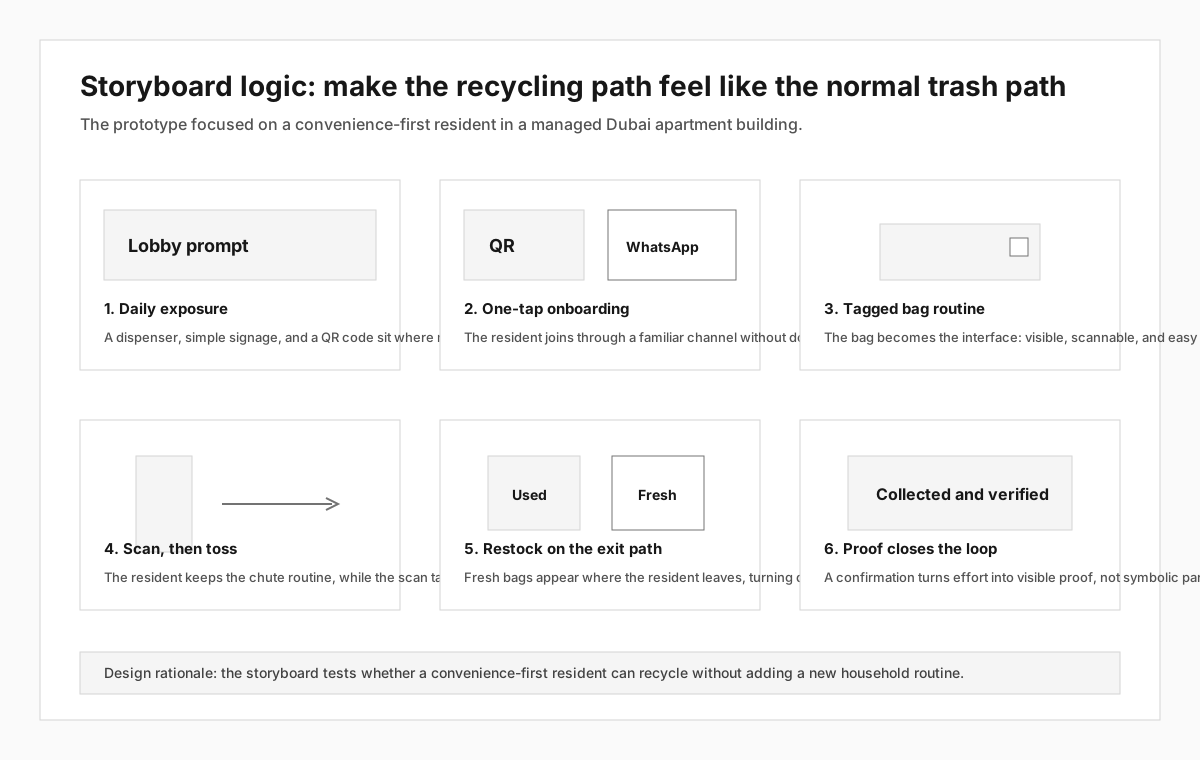
- SCAMPER and storyboard prototyping
- B2B2C pilot economics
Outcome
- Reframed residential recycling from a motivation problem into a building-level service system.
- Designed an anonymized tagged-bag operating model connecting residents, cleaners, property managers, pickups, proof, and restock.
- Separated desirability, feasibility, and payer willingness into target validation gates rather than claiming live operating results.
Residential recycling in Dubai apartments does not fail because residents are morally indifferent. It fails because the better behavior usually asks for more storage, more interpretation, more trust, and more effort than the trash chute. I redesigned the problem as a building operating system: a tagged-bag service that makes the resident action familiar, gives cleaners a safer recovery workflow, gives property managers proof they can justify, and gives the operator enough density to make the model worth testing. The strongest output was not a screen; it was the service logic that made every stakeholder's job easier at the same time.
The failure point was not awareness; it was the handoff between people who needed different things from the same service.
The research started with a familiar public story: residents say they care about sustainability, yet apartment recycling remains inconsistent. The closer look made that explanation feel too thin. In a high-rise, recycling competes with small kitchens, hot corridors, unclear material rules, mixed-bin distrust, elevator friction, delivery packaging, and the simple fact that trash disposal is already designed into the building.
The more important finding came from stakeholder analysis. The resident needs confidence and convenience. The cleaner or FM team needs sealed material, visual clarity, tools, and a workflow that does not become unsafe manual sorting. The property manager needs fewer complaints, clean waste rooms, resident satisfaction, and credible ESG reporting without adding staff or infrastructure. The recycling operator needs clustered demand, predictable pickup volume, and proof that a building can renew the service.
That changed the case. The problem was not "how do we convince residents to care?" It was "how do we make the right behavior easier than the default behavior while keeping the backstage work viable?"
| Stakeholder | What The Research Surfaced | Operating Implication |
|---|---|---|
| Residents | Good intent collapsed when storage, rule ambiguity, extra trips, heat, and invisible recovery made the trash path easier. | The routine had to fit the existing disposal moment, not ask residents to build a second household system. |
| Cleaners and FM teams | Any design that required loose-waste inspection, language-heavy instructions, or extra unscheduled labor would fail backstage. | Recovery needed sealed units, visual identification, tools, staging, and a dignity-first SOP. |
| Property managers | Managers were the likely buyer only if the service reduced operational burden and created credible resident/ESG proof. | The model had to sell a managed amenity, not a resident-paid recycling chore. |
| Operator | Residential pickup becomes expensive when demand is dispersed, inconsistent, or hard to verify. | Buildings had to become the demand unit so route density, restock, reporting, and renewal could compound. |
The task was to turn a messy stakeholder system into one narrow service wedge that could be tested.
The early discovery work used several methods because each stakeholder saw a different version of the same system. The field plan combined extreme-user interviews, guided tour/operator research, activity analysis, observation, persona synthesis, journey mapping, JTBD, HMW questions, SCAMPER, service blueprinting, storyboards, business-model design, assumption ranking, and minimum viable experiment design. That method stack mattered. Without it, the project would have drifted toward a nice recycling app or a generic awareness campaign.
The research narrowed the wedge to dry household recycling in managed apartment buildings. Special streams such as batteries, e-waste, glass, and organics had different safety and logistics needs, so including them too early would have made the first pilot harder to interpret. The design target became narrower and stronger: make dry recycling feel as easy as the normal trash path, then test whether the backstage and business model can hold.
| Method | What It Clarified | Design Decision It Influenced |
|---|---|---|
| Stakeholder interviews and guided tour | Residents, operator-side stakeholders, and building actors had different definitions of a "working" recycling service. | Treat the service as a multi-actor operating model, not a resident-facing feature. |
| Journey map and JTBD | The highest-friction moment was the toss: the point where intention meets storage, rules, distance, and doubt. | Design around the existing disposal behavior instead of asking for a separate recycling ritual. |
| Personas and HMW framing | The convenience-first resident was the hardest adoption case and therefore the strongest design target. | Use a low-friction onboarding and bag routine that works before adding richer motivation features. |
| SCAMPER | The idea set moved from app, rewards, sensors, and infrastructure toward a reusable QR/NFC bag as the common object. | Make the bag the shared interface across resident behavior, cleaner recovery, operator tracking, and manager proof. |
| Assumption ranking | The riskiest assumptions were resident use, cleaner recovery, and manager budget commitment. | Split validation into three MVEs instead of relying on one resident prototype. |
The tagged bag became the operating object because every stakeholder could read it.
The key design decision was deliberately physical. A dashboard alone would not solve the resident routine. A rewards layer alone would not solve backstage recovery. A new bin system could create approval, space, and maintenance friction before basic behavior had been validated. The tagged reusable bag gave the system one common object: residents know what to use, cleaners know what to recover, the operator can verify and restock, and managers can connect participation to reporting.
SCAMPER helped move the concept from feature inventory to service architecture. QR/NFC tagging, WhatsApp-first onboarding, reusable bag durability, a premium object language, building-level leaderboards, delayed reward confirmation, service-charge integration, and janitor SOPs were not separate ideas. They were different ways to solve the same handoff problem.
| Design Move | Why It Exists | Tradeoff | So What |
|---|---|---|---|
| QR/NFC tagged bag | A bag can carry identity, material category, recovery signal, and reward proof across the system. | It needs sourcing, durability, restock, and clear loss/replacement rules. | The interface becomes the thing residents already handle, not an extra screen. |
| WhatsApp-first onboarding | Residents already understand the channel, so the service avoids app-download friction in the first test. | The experience is lighter than a full product and needs manual operation in the MVE. | A low-tech channel can be the fastest way to test the behavior honestly. |
| Dignity protocol for cleaners | The model fails if recovery means unsafe contact, hidden sorting, or language-heavy instructions. | Tools, signs, training, and staging zones add operating cost. | Cleaner workflow is not backstage detail. It is the feasibility gate. |
| Manager reporting | The payer needs proof: participation, recovery, resident response, and ESG-style evidence. | Reporting must be credible while keeping pilot data's precision honest. | Proof turns recycling from goodwill into a managed amenity. |
| Building subscription logic | Direct resident willingness to pay was fragile; the building had stronger economic reasons to fund the service. | The sale becomes a manager/developer conversation as well as a resident adoption play. | The business model becomes part of the design, not a separate spreadsheet after the fact. |

The service blueprint forced the business model into the design conversation.
The blueprint made the hidden dependencies visible. If the resident scans but the cleaner cannot recover the bag safely, the experience is false confidence. If the cleaner recovers bags but the manager cannot see proof, renewal is weak. If the manager likes the idea but pickup density is poor, the operator carries the loss. That is why the model moved away from a resident-paid subscription and toward a B2B2C building model.
The building pays because it receives a managed sustainability amenity: cleaner waste rooms, resident-facing proof, ESG-style reporting, and a program that can be added without rebuilding the building. Residents participate without feeling a new direct fee. The operator gets a more concentrated pickup unit, reusable reporting, and a clearer path from one building to a portfolio.
| Layer | Design Question | Evidence-Backed Choice |
|---|---|---|
| Desirability | Will a convenience-first resident use the system when the trash chute is still easier? | Keep the routine close to trash disposal: scan the bag, toss as usual, receive proof later. |
| Feasibility | Can cleaners recover sealed bags without unsafe sorting or extra unmanaged labor? | Use visual tags, tools, staging, and a short SOP co-designed around cleaner constraints. |
| Viability | Who pays for recycling when residents value the outcome but resist a new direct subscription? | Make property managers the buyer and residents the users, funded through the building service model. |
| Scalability | Can the operator expand without dispersed, low-volume pickup economics? | Use building clusters, repeatable onboarding, reusable reports, and portfolio expansion logic. |
The result was a testable operating model, not a decorative recycling concept.
The final output connected four things that are often treated separately: resident behavior, cleaner workflow, manager value, and operator economics. That is what makes the case work as service design; it does not stop at the visible journey, it explains who has to do what, what makes that action rational, where the model could break, and how to test each failure mode before scale.
The MVE design was deliberately split into three tests because each actor had to validate a different part of the system: a resident test alone would have produced false confidence, a backstage test alone would not prove demand, and a manager conversation alone would not prove operations.
| Validation Gate | What It Tests | Designed Target | Decision It Supports |
|---|---|---|---|
| Frontstage behavior | A 4-6 week resident pilot with tagged bags and QR/WhatsApp participation. | ≥30% weekly household participation with consistency after week four. | Whether the routine survives beyond novelty. |
| Backstage recovery | A simulated chute-room or staging flow where cleaners identify, extract, and stage sealed bags. | ≥90% recovery, ≤20-30s extraction, zero unsafe contact, and no hand-sorting. | Whether the model respects cleaner constraints and can run inside real operations. |
| Payer commitment | A manager review using pilot KPIs, a pricing sheet, and sample ESG/compliance reporting. | Clear continuation intent or conditional commitment if pilot targets are met. | Whether the building sees enough value to fund the service. |
The strategic value is the reasoning pattern.
The strategic value is the operating pattern: start with human behavior, then keep going until the business logic and delivery constraints are visible. A service idea is only real when the incentives, workflows, proof points, and validation gates can survive outside the deck.
Looking for similar results?
Let's discuss how I can help you achieve your goals.
Let's move your product forward
Working on something that needs a clearer path from strategy to execution? Let's talk. I typically reply within 24 hours.