The zoom problem and fractal navigation
-
 Moe Hachem
 - March 6, 2026
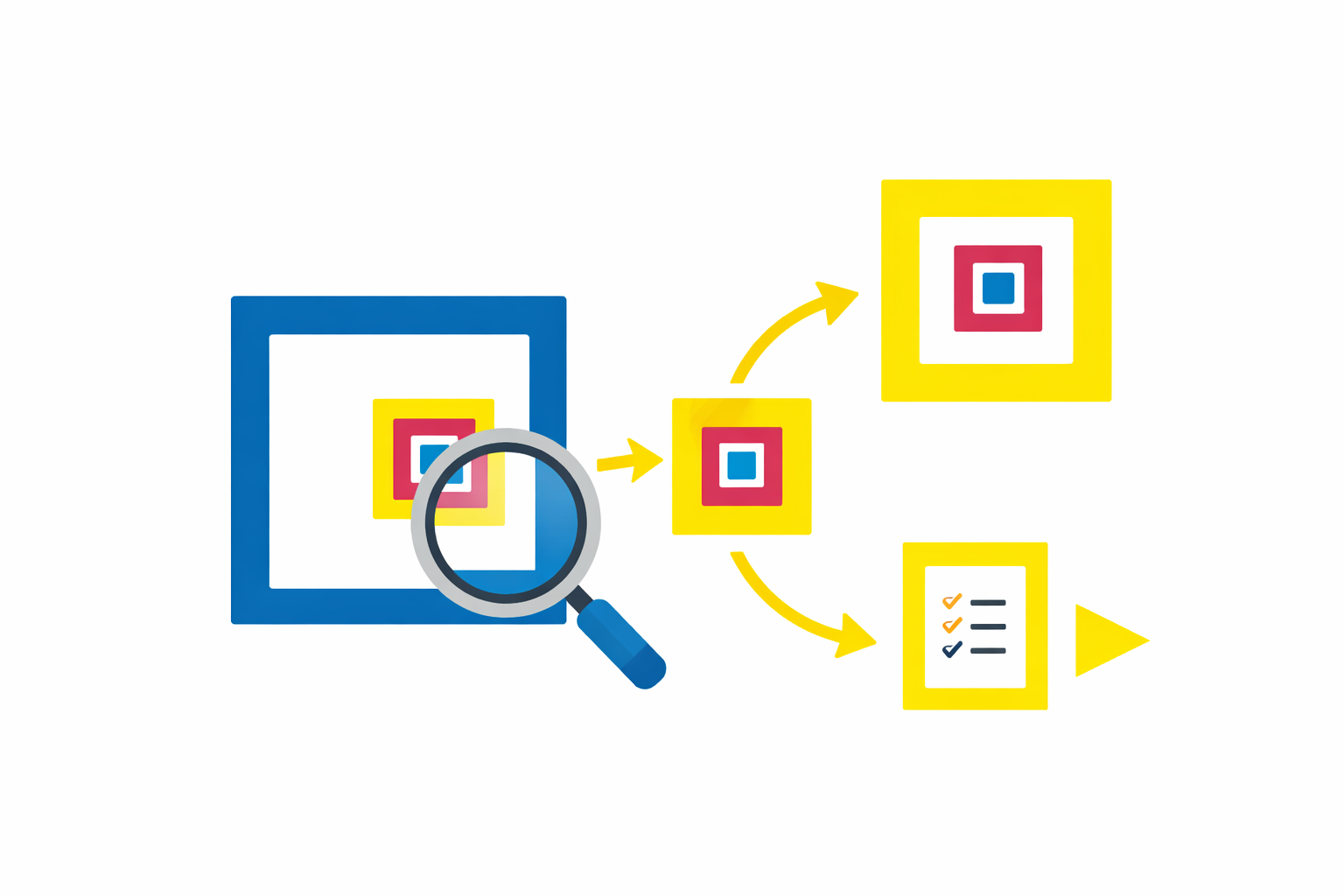
Most tools force you to choose:
- Zoom out and you lose the detail.
- Zoom in and you lose the map.
Here’s a problem I kept running into when mapping a methodology:
At the top level, the system made sense. You could see the structure — the relationships, the dependencies, the flow. Clean, legible, strategic.
But every top-level node contained a world: sub-problems, decisions, patterns that needed their own map.
If you’ve ever tried to show depth while trying to keep that gestalt, that top level collapsed into noise.
It’s what my old dear professor Jay Randle once described as: the zoom problem.
He brought this up in the context of architectural drawing, where in the not-so-distant past, architects would draw their plans on drafting boards. They were able to zoom in to a detail, and zoom out to see the whole, simultaneously.
He argued that digital tech simply doesn’t allow us that level of gestalt. You either see the tree, or the forest, but you can’t see both because you’re limited by a screen viewport smaller than your own viewports (your eyes).
Strategy that can’t zoom in becomes disconnected from execution. Execution that can’t zoom out loses the thread.
Every tool I tried forced me to pick a level and stay there:
- Sprawling mind maps that were useless at scale
- Nested docs that hid the shape of the thing
- Whiteboards that fit one level beautifully and broke immediately at two
So I built something that solves it differently.
Every node can contain an entire map. You navigate by zooming in and out to reveal more detail. The structure at any level looks like the structure at every level.
Think of it like fractal navigation: infinite depth without losing the top, while still working within the limitations of a desktop.
The product is still in testing and I’m looking to open up a BETA very, very soon. If you’re interested, please contact me, and I’d love to walk you through it.